
By Rebecca Lenehan
Artisans of Cashel- The Stories of Craftspeople in Our Community.
Deep in the rich Tipperary countryside near Moyglass, where wind turbines peep over the brow of the hill, nestles Beechmount, a Georgian farmhouse and home of the Grubb family for over 80 years. As I drive along the lanes brimming with cow parsley, I am struck by the juxtaposition of change and constancy in this rural landscape.
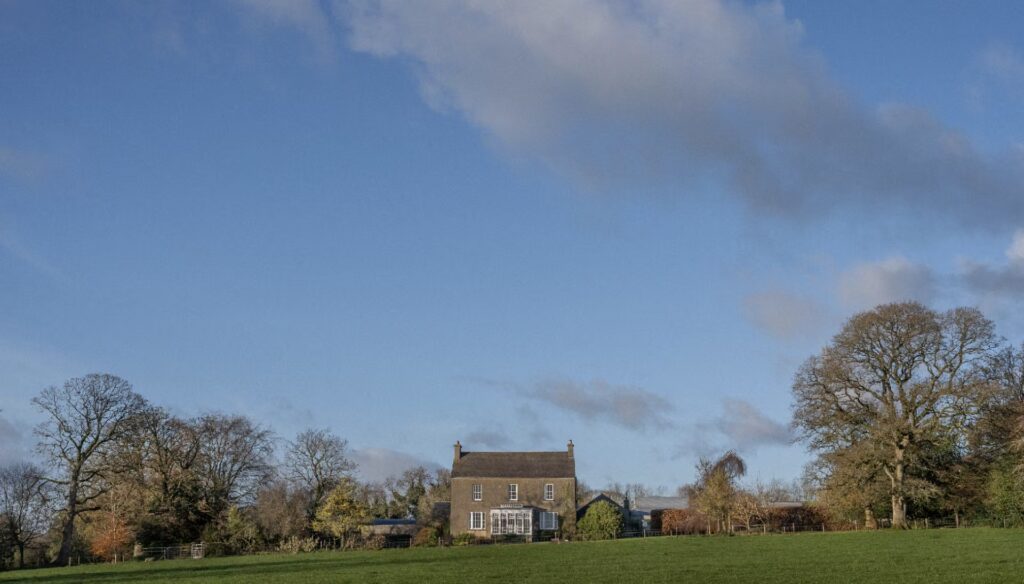
When her parents, Jane and Louis Grubb, relocated to a more practical bungalow nearby several years ago, Sarah and Sergio Furno and their three children, Luca, Anna and Leila moved into Sarah’s childhood home. Beyond the cobbled farmyard is the purpose-built Dairy Unit completed in 2010 where over 40,000 wheels of Cashel Blue rest at different stages of maturing.
I have come to meet mother and daughter Jane Grubb and Sarah Furno of Cashel Farmhouse Cheesemakers and hear the story of Cashel Blue, a story that began with Jane making cheese in their farmhouse kitchen over 40 years ago. Clearly but quietly spoken, still and watchful, Jane often smiles as she speaks. She describes the basic farmhouse kitchen as it was then with whitewashed walls, a concrete floor, two dressers and a scrubbed pine table. It was often freezing.
Having taken custodianship of the family farm and set up a small dairy herd in the late 1970s, Jane and Louis soon came to the realisation that they should process the milk themselves. After a weekend’s cheesemaking course in Kilkenny, Jane adapted catering equipment to her own purposes. Taking a wide-based copper preserving pan, she poured in milk and put it on the large gas cooker to warm so it was lukewarm.
Jane also made her own starter cultures (like buttermilk or yoghurt). Sometimes they would fail and, devastatingly, she would lose the whole lot. It was exhausting. Sarah, at age five remembers her mother getting up at 3 o’clock in the morning to take the cultures off the heat and begin to make cheese.
Their first cheese was Quark, which settled in buckets on top of the dresser. Jane then began making a type of Cheshire called Fethard and a Caerphilly called Ballingarry. She would sell the cheeses in the Country Market in the Town Hall in Fethard, getting up early in the morning to be set up by 8am. She loved it, making good friends there over the years.
An off-the-cuff remark at the Spring Show at the Royal Dublin Society changed everything. Louis asked Avonmore, their Co-Operative, why they were importing Blue Cheese. They said, “if you could make it, we would sell it.” It made them think.
Developing a cheese recipe takes years. Remarkably Jane and Louis persisted, never wavering in their determination despite set-backs. “We made many mistakes,” Jane says. “But trial and error brought us to Cashel Blue.”
Jane gave cheese to family and friends to try. “We nearly poisoned them all. They’d get too much and they’d wade through it,” she laughs. Myrtle Allen, of Ballymaloe Hotel, asked to taste some. “She was very encouraging,” Jane says. “As was Declan Ryan from Arbutus Restaurant.”
Jane was helped in her quest by fellow cheesemakers Jim McCarthy and John McCarthy from Mitchelstown Co-Operative. Then, by chance, her father met a retired German Cheesemaker, Bruno, who later came to visit them. “He was a great help. He got me cutting the curd and he would say, ‘Jane, you do it now! Now! You can’t wait!’” Jane laughs.
“The three things you want are acidity, temperature and feeling,” she says. The first two requirements are easily measured but the latter is less tangible. Bruno gave Jane the confidence to trust her instincts.
In 1984, they won their first award in the Clones Show in Monaghan, celebrating together that night at Chez Hans. Sarah, then six years old, had never been before.
Cheese was an integral part of Sarah’s childhood. It was only later in life that she realised not everyone had the same experience. “As a young child I ate very young Cashel Blue, which was more like feta with an impression of blueness, fresh and sharp as distinct from creamy and spicy,” Sarah says. “As a teenager I started to get into mature cheese, a favourite was Cashel Blue on toast with sliced tomato!”
Jane’s favourite recipe with Cashel Blue is a very simple recipe Darina Allen had as a starter: just celery sticks stuffed with Cashel Blue. Sarah opts for simplicity too, marrying a piece of strong Cashel Blue with a drizzle of Galtee acacia honey.
Chefs were very important in popularising Cashel Blue. “Chefs give people confidence,” Sarah says. “People need to be shown how to use an unfamiliar product.” Chefs also influence supermarkets and other chefs. The word about Cashel Blue spread.
As demand increased, production was eventually moved to an old stable in the farmyard. Gradually, more of the farm buildings were taken over until in 2010 the family made the move to a modern cheesemaking premises a field away.
In 2003, Sarah and her Italian husband Sergio, who had been working with cheesemakers and in the wine industry in France, came to visit for a holiday. They had plans to set up their own importation and exportation business in speciality Irish food from Italy and France, but that all changed.
Jane had already retired, finding the work exhausting. “I physically couldn’t do it, my back was packing up,” she says. Louis was running the business and frequently travelling to America. It became obvious to Sarah and Sergio that the family business needed their injection of energy. They also saw an opportunity to develop a whole aging system for the cheese.
“It’s a very intimidating thing to get involved in a family business,” Sarah says. “But I think it’s a privilege to have seen how something is produced.” Jane is very proud of her daughter. “She works too hard though,” she says.
Sarah spends a lot of her time people-managing now, going to trade shows to educate cheesemongers and judging cheeses at international awards. She has judged at the Swiss Cheese Awards and would love to go to Japan to judge next when the children are older.
Mother and daughter talk of the danger of exhaustion. “We’ve seen burnout and several suicides in the cheese industry, a lot of it,” Sarah says. “It’s trying to do everything and be everything to everybody.” This knowledge gives sharing the load within the family a keener importance.
When Sarah and Sergio joined the family business, an Irish sheep’s milk blue cheese, Crozier Blue, developed by a cousin, was also being made alongside Cashel Blue. Many of the family are involved in Cashel Farmhouse Cheesemakers, another cousin works at the Dairy Unit, and another designed and runs their excellent website with Sarah. A family member has a seaweed harvesting business and Sarah and Sergio have been looking into ways of using seaweed in cheese recently.
Although the recipe was developed in the 1980s, Cashel Blue is still evolving. They embrace these changes rather than attempting to equalise everything.
“The cheese is a lot creamier than it was traditionally. Cashel Blue today versus Cashel Blue five years ago is a totally different cheese and the reason is the milk has changed so much,” Sarah says.
She is relishing working with what nature is giving them, the creaminess coming from the natural breakdown of proteins and fats. It keeps her interest.
Despite the modern Dairy Unit, the artisan aspects of cheesemaking are still consciously maintained and fought for. “It’s important to keep the essence of craft, that contact with the curd. In industrial cheesemaking you can’t actually see the curd. It’s a fully closed system,” Sarah says.
Sarah and Sergio developed a hard sheep’s milk cheese, Shepherd’s Store, about 7 years ago, and are now working on a hard cow’s milk cheese made with an animal rennet from a family-owned rennet producer in France.
“It’s loosely based on a Gruyere recipe,” Sarah says.
Jane is immediately interested.
“Everything went wrong, Mum,” Sarah laughs with a characteristic booming laugh.
Jane gives a knowing laugh in return. “Oh, right!”
Yellow in colour with a natural rind (Sarah abhors wax!) the new, as yet unnamed, cheese is nutty in taste, a little chewy and dry salted. I feel honoured to be one of the first to taste it.
In a world of their own, Sarah and Jane talk with a shared understanding of the trial and error inherent in cheesemaking. “Well, it’s worked,” says Jane. Something that could be said for the journey that led them to Cashel Blue too.
And what of the future? “I’m relatively positive about the industry,” says Sarah. “It’s a very funny time. A lot of people are choosing not to make cheese at the moment because of rampant inflation.”
With no third generation cheesemaking families in Ireland, might the children join the family business? “We’ve encouraged them to travel within the food industry,” Sarah says. Being one family, one recipe, brings an added responsibility to maintain diversity of ownership but with their shared love of food and careful custodianship, the future of Cashel Blue is assured in the hands of the Grubbs and Furnos.
As I drive away from Beechmount, the wind turbines dip out of sight and I wonder at how, despite modernisation, Cashel Blue resolutely maintains its links to this lush landscape and a time when Jane first took a copper preserving pan and poured in milk from their own herd of cows.
Can be enjoyed by those sensitive to Lactose - Did you know the lactose, i.e the natural sugars in the milk, are fermented out over time.
Ingredients: Pasteurised cow’s MILK, salt, rennet, starter cultures and Penicillum Roquefortii.
Allergy Advice: Contains milk
Cashel Blue®
Country of Origin: Ireland
Established: 1984
Milk Type: Whole Cow’s Milk
Pasteurised: Yes
Rennet: Vegetarian
Style: Semi-Soft, Blue
Nutritional Information:
Typical values per 100g:
Energy - 1444kJ / 348kcal
Fat – Total Fat: 28.8g
Saturated Fat: 18.4g
Monounsaturated Fat:7.2g
Polyunsaturated Fat:0.8g
Trans Fats: 1.0g
Carbohydrate (by difference): 0.9g
Sugars: 0.2g
Protein: 20.4g
Salt: 2.0g